
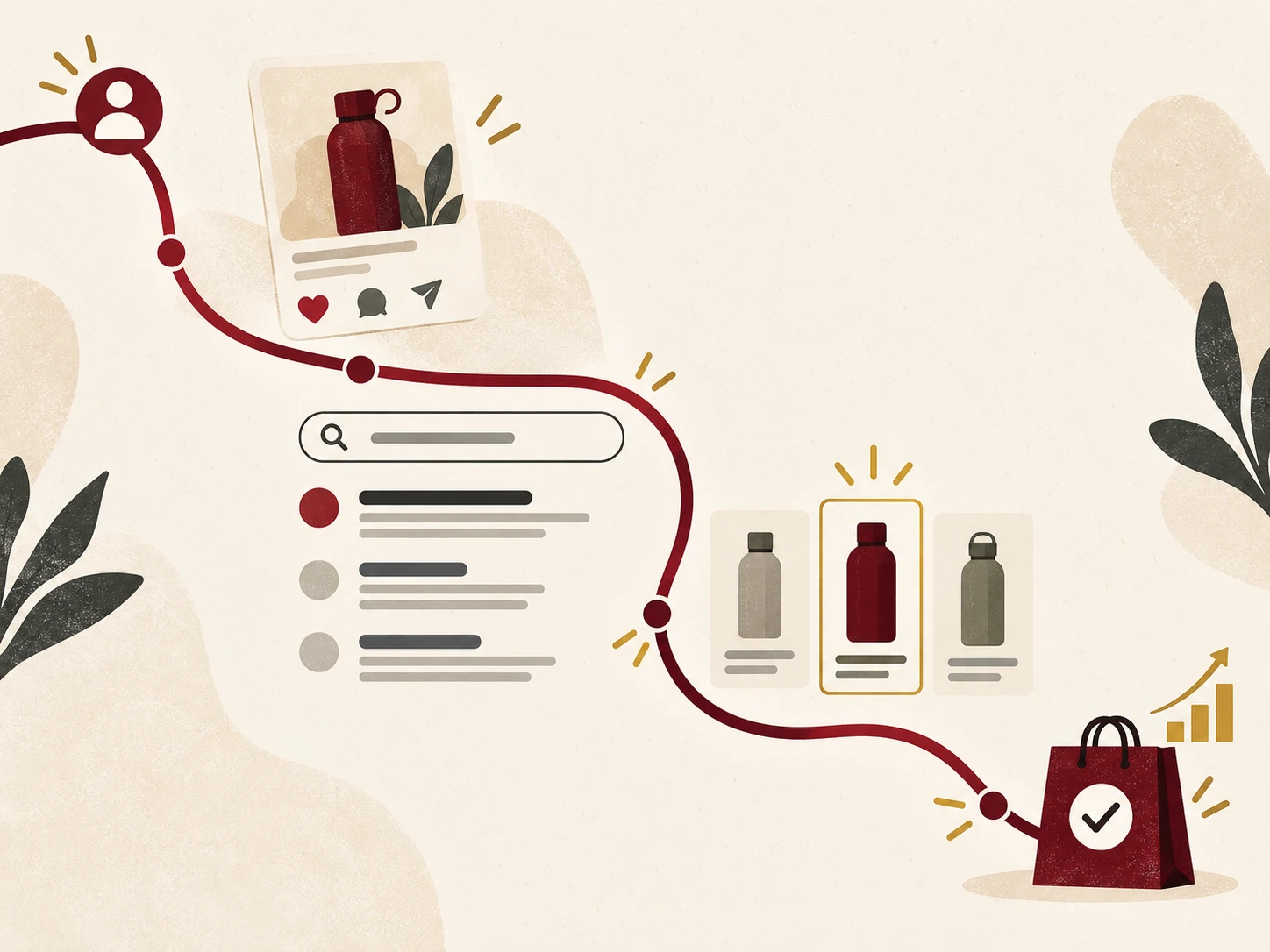
Most Malaysian SMEs run three separate budgets without ever calling them that: "the Facebook budget," "the Google budget," and whatever gets spent boosting the Shopee or Lazada listing. Three line items, often three different people or agencies managing them, rarely talking to each other. The problem is that the customer never experiences your business in three separate pieces. They see one ad, then check one thing, then buy in one place. Splitting the budget doesn't split the customer's journey. It just means nobody's looking at the whole thing.
What is full-funnel marketing?
Picture a funnel with three stages. At the wide top, people have never heard of you. In the middle, they know you exist and are deciding whether to trust you. At the narrow bottom, they are ready to buy and the only question is whether you make it easy. Full-funnel marketing means planning for all three stages together, instead of spending everything on one.
For a Malaysian SME, the stages usually map onto channels you already pay for. A paid social ad introduces you to people who were not looking. A Google search for your name, or for what you sell, is the middle, where they are checking you out. A marketplace listing, a landing page or a WhatsApp message is the bottom, where the sale actually happens.
The reason to treat it as one system is that each stage feeds the next. Strong awareness with a weak middle sends people away just as they get curious. A strong bottom with no awareness has nobody to sell to.
One customer, three touchpoints
Here's the path that actually happens, more often than not: someone sees a paid social ad for your product, gets curious, and searches your brand name on Google before buying, not because they forgot the ad but because that's how people vet a business they don't know yet. Then they either check your site directly or compare you against the same listing on a marketplace. If your search budget and your social budget are run by two different people with two different reports, nobody owns that middle step. Which means nobody notices when a competitor starts bidding on your own brand name, catching the exact customer your social spend just warmed up.
What running it as one system actually looks like
This isn't about merging platforms into one dashboard for the sake of tidiness. It's about a few specific things actually happening on purpose:
- Search campaigns defend your brand terms, because the social spend is the reason people are searching your name in the first place, and that search moment is the cheapest, highest-intent click you'll ever get.
- Audience and creative data move between channels instead of resetting to zero each time: a concept that works on paid social gets adapted for shopping ads, not rebuilt from scratch three times by three separate teams.
- Attribution looks at the full path, not just the last click, so the marketplace sale that "came from nowhere" gets correctly traced back to the social ad that actually started it, instead of making paid social look like it's underperforming.
"Three budgets, one customer. The mix has to be built as one system, or you're just paying to confuse your own funnel."
A simple way to see how your budget is really split
You do not need software for this, only last month's spend and ten minutes. List every channel you paid for, and next to each one write which stage it mainly serves: finding new people, convincing people who already know you, or closing the sale. Then add up the total for each stage.
There is no magic ratio, because the right split depends on your business. What you are looking for is lopsidedness: nearly everything spent on finding new people with nothing to catch them afterwards, or nearly everything on closing with nothing refilling the top. Either one shows you where the money is leaking, and sorting that out is the core of good performance marketing.
Then add one more column: who is responsible for each line. If the answer is three different people, each looking at a separate report, fix that first. It is how the gaps between stages go unnoticed.
Where to actually start
You don't need to rebuild everything this week. Start by checking three things: whether your own brand name is protected in search right now, or a competitor is quietly bidding on it; whether the creative running on social exists anywhere near your marketplace listings, or looks like it was made by two unrelated businesses; and whether anyone can currently see the full path a customer takes across all three channels, or if each one only reports what happened inside its own walls. Most of the time, the fix isn't more budget. It's making the budget you already have stop working against itself.
This is the exact problem our Funnels & Pipelines service is built to fix: connecting the landing pages, tracking, and CRM stages so a customer's path is treated as one system instead of three disconnected reports.
Keep reading: Why Search Is Now Three Engines, Not One and What Makes a Landing Page Actually Convert.