
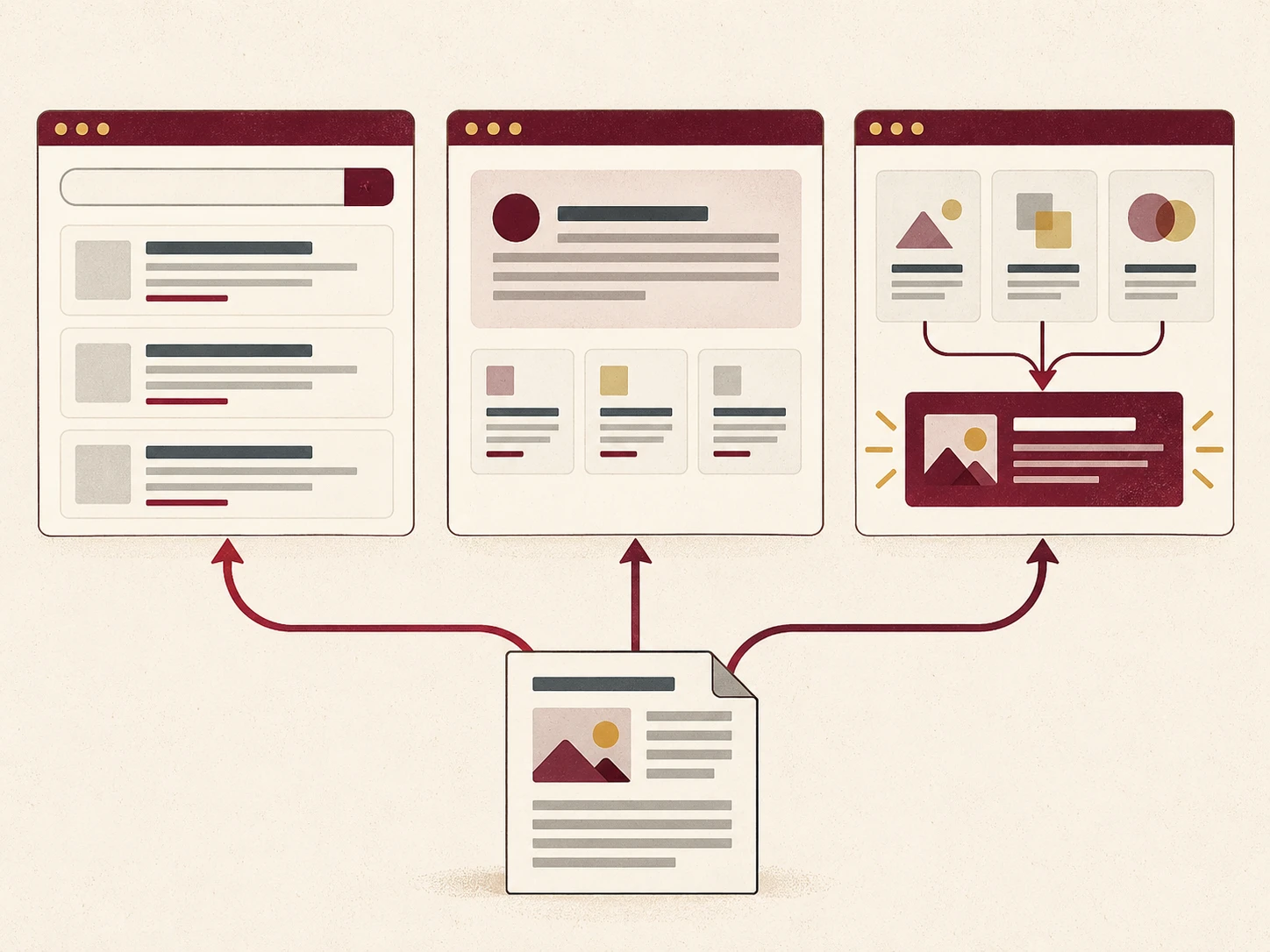
Ask ten business owners where customers find them online, and most will still say "Google." That's not wrong, it's just incomplete. A growing share of people now start that same search inside ChatGPT, Perplexity, or an AI Overview instead of a traditional results page, and none of those systems read your website the way Google's crawler does.
Three different jobs, not one bigger job
Classic SEO is still the floor everything else stands on: a fast site, clean technical health, and pages that actually answer what someone typed in. AEO, Answer Engine Optimization, is a different job entirely. It's about being the source an AI assistant quotes directly when it answers a question, often without the person ever clicking through to your site at all. GEO, Generative Engine Optimization, goes a step further still: it's about how an AI describes your business when it's generating a recommendation or comparing you against competitors, not just citing a fact.
A page sitting on page one of Google can be completely invisible inside an AI-generated answer, because the two systems aren't measuring the same thing. Google is still largely weighing link authority and how closely a page matches a search query. The AI engines are weighing something else entirely: how clearly a page states its answer, how cleanly it's structured, and how easy it is to lift a clean quote out of it.
What this actually changes
- Content needs its answer stated plainly near the top, not buried three paragraphs into a long introduction.
- Structured data and clean markup matter more than before, since AI systems are parsing structure, not reading prose the way a person does.
- What gets said about your brand elsewhere (reviews, forums, press) increasingly shapes how generative engines describe you, even on pages that never link back to your site.
"One website, three different audiences reading it. Build for all three, or only get found by one."
Can you get your business to show up in ChatGPT?
It is one of the questions we hear most, and the honest answer is that nobody can guarantee it. The AI tools decide what to say, and no agency, ours included, controls that. What you can do is make your business easier to find, easier to understand and easier to trust, which improves the odds.
Many AI assistants answer by gathering what they can find about a topic and summarising it. So the businesses that get mentioned tend to be the ones that are clearly described in places the AI can read. A few of the things that decide that are in your hands:
- State what you do in plain words. Your homepage should say what you sell, who it is for and where you operate within the first few lines, not behind a clever slogan.
- Keep your details identical everywhere. Your business name, address, phone number and service descriptions should match across your website, your Google profile and your directory listings.
- Get mentioned by other sources. Reviews, directory listings, interviews and articles on other sites give AI tools more to draw from than your own website alone.
- Do not block the crawlers by accident. A single line in a small file called robots.txt can shut AI crawlers out of your whole site. It is worth checking that yours does not.
A five-minute check you can do today
Before you change anything, find out where you stand. Open ChatGPT or Perplexity and ask the question a customer would ask, for example "who are good accountants in Kuala Lumpur for a small business?" Then search the same question on Google. Write down three things: whether your business appears, who does appear, and what the answer says about them.
If competitors are named and you are not, look at how they describe themselves and where else they are mentioned. If you appear but the description is wrong or out of date, the fix is usually on your own pages and listings. If nobody is named at all, that is an opening, because a clear, well-structured page has less to beat.
Repeat the check once a month and keep the answers in a note. AI answers can change from one day to the next, so a single check proves little. A pattern over a few months tells you whether your changes are working.
Where to start
None of this replaces the basics. A fast, genuinely useful site is still what everything else gets built on top of. What's changed is the scope: a real search strategy now has to account for how AI systems read, extract, and repeat what's on a page, not only how a crawler indexes it.
This is exactly what our SEO, AEO & GEO service is built around: making the same page perform across all three systems, not just the one you already know how to measure.
Keep reading: The Full-Funnel Media Mix, Explained and What Makes a Landing Page Actually Convert.