
Most businesses blame the ad when a landing page doesn't convert. Nine times out of ten, the ad did its job, it got someone curious enough to click. What happens in the next three seconds on the page is where the sale is actually won or lost.
What is a landing page conversion?
A conversion is the moment a visitor does the one thing the page was built to get them to do. On a landing page that might be sending an enquiry form, booking a call, phoning your number or paying for something. A visit is not a conversion, and neither is a scroll. Only the action that moves someone closer to becoming a customer counts.
What counts depends on the business. For a clinic it is a booked appointment, for a law firm a consultation request, for an online shop a completed checkout. Pick the action that sits closest to revenue and count that one.
The conversion rate is the share of visitors who take that action. If 200 people land on your page in a week and 8 of them fill in the form, your conversion rate is 4 percent. Those numbers are only an example of the sum, not a benchmark to aim for. The sum is always the same: people who took the action, divided by people who visited, times 100.
It matters because it shows what your ad spend is really buying. Say the same ad sends 200 visitors to two different pages, and one page gets 8 enquiries while the other gets 2. The ad did not change. The page did. That is why we check the page before anyone blames the ads.
The page only has one job
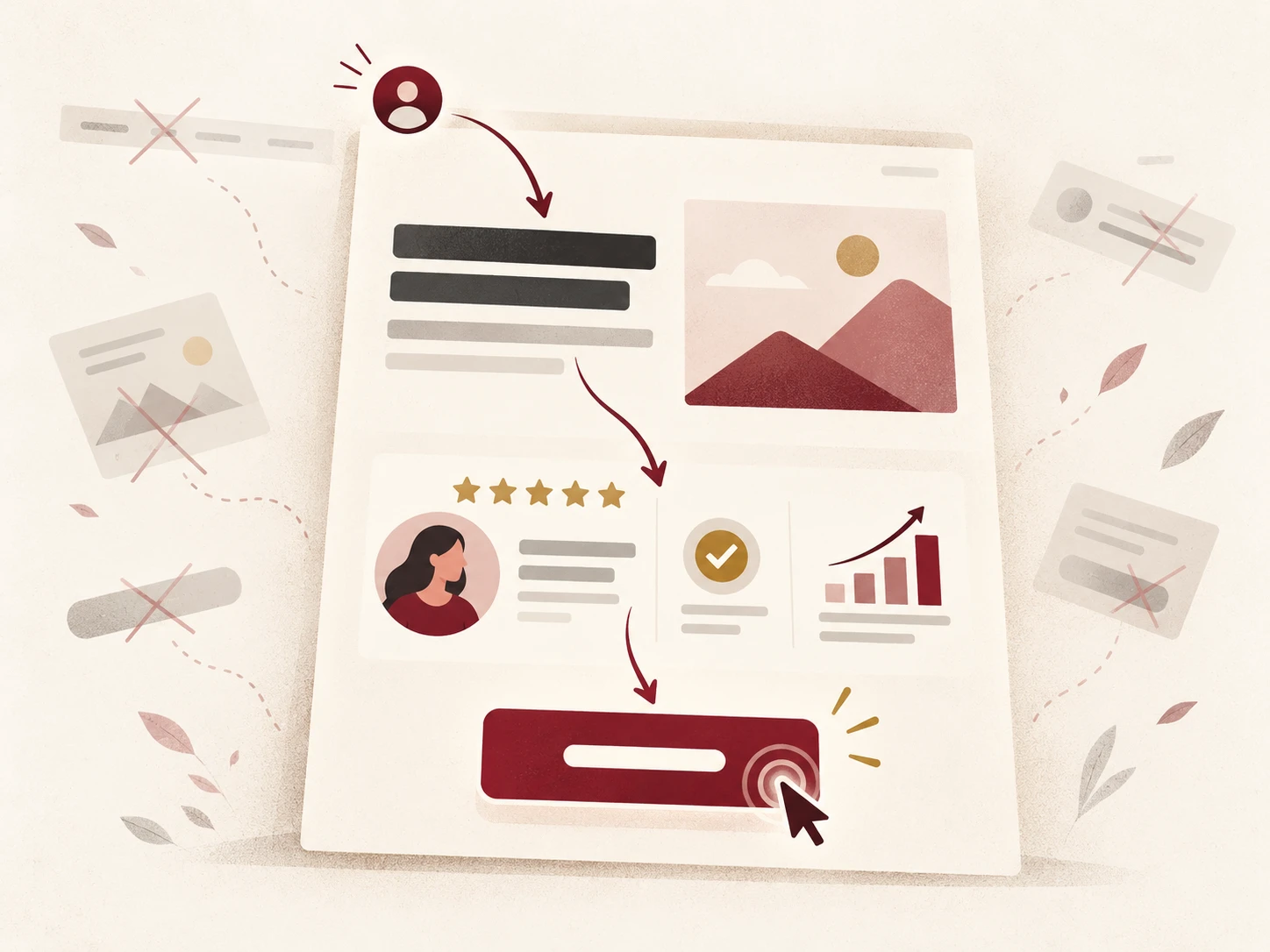
A landing page isn't a mini website. It's not there to explain your whole company or list every service you offer. It has one job: get the visitor to take one specific action, whether that's filling in a form, booking a call, or making a purchase. The moment a page gives someone three things to think about instead of one, conversion drops. Every headline, every image, every line of copy should point at the same single action.
This is the same principle behind a well-built landing page or funnel: the entire structure exists to remove decisions, not add them.
Speed and clarity beat clever every time
A landing page that takes four seconds to load has already lost a meaningful share of its visitors before they've read a word. Beyond speed, the page has to answer three questions almost instantly: what is this, who is it for, and what do I do next. If a visitor has to scroll and think to figure that out, the page is already working against itself. Clear, specific copy about a real outcome will always outperform a clever headline that needs explaining.
"A landing page doesn't need to be clever. It needs to be instantly obvious."
Trust has to show up before the ask does
People don't convert on a page that feels like a stranger asking for their number. Real reviews, a specific result, a recognisable logo, or a straightforward explanation of what happens after they click, these do more for conversion than another design tweak. The businesses that get this right treat trust signals as part of the page's structure, not decoration added at the end.
How to tell whether your landing page is converting
You do not need a complicated dashboard to find out. Three simple checks tell you most of what you need to know.
- Pick the one action that counts. Decide whether it is a form, a call or a purchase, and count only that. If you count everything, you are measuring nothing.
- Make sure it is actually being tracked. The usual way is to send people to a thank-you page after they act, then count the visits to that page. If nobody can show you that number, you are guessing.
- Look at it on a phone first. Plenty of your visitors will arrive on one, so open your page on yours, on mobile data rather than office Wi-Fi, and see whether the main message and the button appear without scrolling or waiting.
Once you have a number, change one thing at a time. If you rewrite the headline, swap the photo and move the button in the same week, you will never know which change helped. Give each change enough visitors to show a pattern before you judge it, and write down what you changed and when.
Getting a landing page to actually convert isn't about one big redesign. It's usually two or three specific fixes, applied to the right part of the page. If you want to know exactly which ones apply to yours, get a free audit and we'll tell you straight.
Keep reading: Why Search Is Now Three Engines, Not One and The Full-Funnel Media Mix, Explained.